—
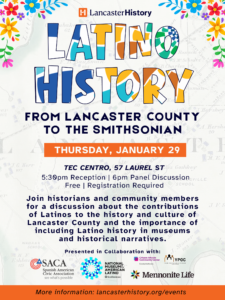
Mennonite Life colabora con LancasterHistory, SACA, la Red de Jóvenes Profesionales de Color del Centro Comunitario Crispus Attucks y el Museo Nacional del Latino Americano para presentar una recepción y un panel de discusión el jueves 29 de enero a las 17:30.
—
From food, sports, and the arts to business, politics, and education, Latinos have influenced every aspect of life in America and in Lancaster County. In Washington, D.C., the Smithsonian Institution is working to build a new museum, the National Museum of the American Latino (NMAL), to honor this history. On Thursday, January 29th, LancasterHistory will host curators from NMAL to share information about their museum alongside the work of local scholars and community groups who have been serving the Latino community and preserving its history locally for many years. In this panel discussion, we will explore the contributions of Latinos to the history and culture of Lancaster County and discuss the importance of including Latino history in museums and historical narratives.
The panel will feature Amanda Elena Brito and Robin Morey of the National Museum of the American Latino, Dr. Ivette Guzman-Zavala and Dr. John Hinshaw of Lebanon Valley College, and Ramona Rivera Navedo of Lancaster County. The panel will be in English and Spanish.
This panel is presented in collaboration with:
- SACA is a community organization that uplifts and restores marginalized communities through human, economic, and social services, while supporting cultural identities.
- Crispus Attucks Community Center’s Young Professionals of Color Network is a free member collective where young BIPOC professionals can network and engage in conversation on social and civic issues.
- Mennonite Life shares items and stories featuring the diverse lived experiences and faith values of Lancaster Mennonites and interrelated communities. Mennonite Life stewards a research library, permanent museum collection, and family friendly experiences at the 1719 Museum and Biblical Tabernacle Experience.
- The National Museum of the American Latino is part of the Smithsonian Institution. The museum honors the dreams, challenges, and triumphs of U.S. Latinos, elevating those stories within the nation’s narrative.
Information & Registration
The panel will begin at 6pm and will be preceded by a reception at 5:30pm at Tec Centro, 57 Laurel St, Lancaster, PA. Parking is available in a large lot at the facility. In case of bad weather, the panel will be conducted virtually. This program is free and open to the public, but does require registration to guarantee space. To register, please click here or call 717.392.4633, ext. 100 to register over the phone.